
Sustainable area development
Want to know more about BREEAM?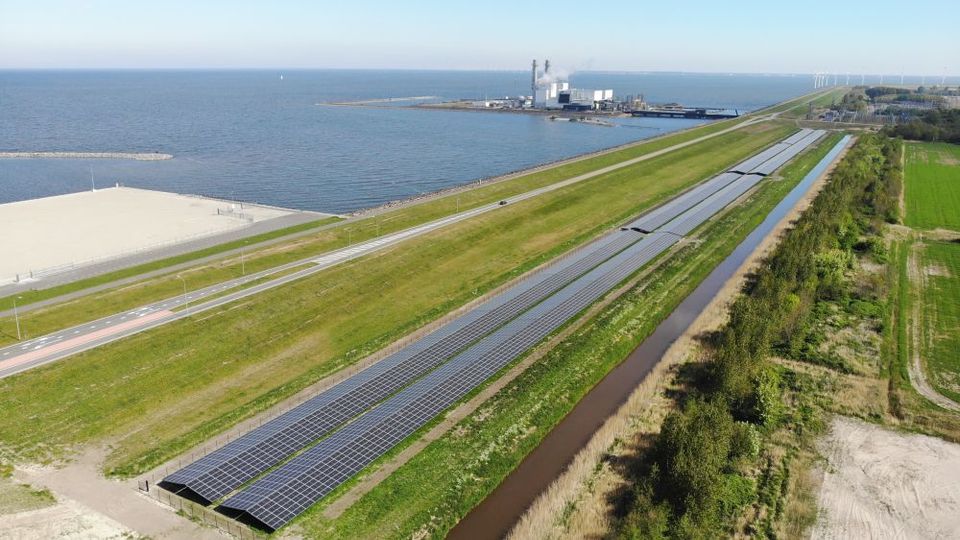
Flevokust Port and BREEAM
"We are working towards a green and sustainably developed area. "
Marc Brouwer, (BREEAM) Certification Manager at Lelystad Municipality
What is BREEAM?
BREEAM stands for 'Building Research Establishment's Environmental Assessment Method'. Simply put, BREEAM is a globally recognised method for objectively qualifying the sustainability of an area or building (company). The BREEAM-NL Area certificate was specially developed for areas undergoing (re)development, such as Flevokust Haven. Certification is based on six main categories:
- Management
Work through the development process with stakeholders to create a business park that is developed as sustainably as possible and also economically future-proof. - Synergy
Achieving economic, ecological and social added value based on integral cohesion of area-specific qualities - Source
Reducing CO2 emissions and using natural resources efficiently - Spatial planning
Maximising safety, environmental quality, ecological quality and efficient land use - Well-being and prosperity
Achieving a safe, attractive and socially cohesive environment and a healthy economy - Area climate
Achieving a healthy and future-proof physical living environment
Read more about these categories and the exact points that are assessed further down this page.
After going through all categories, a total score in points follows. Those points are translated into stars. A maximum of five stars can be awarded. "Lelystad's ambition is to achieve the qualification 'Excellent' (four stars)" and if possible better. Then there is recertification every three years. Then, based on mandatory monitoring of Energy Consumption etc., it will be assessed whether investments in sustainability are also paying off as intended in the management of public spaces."
Why BREEAM?
An area that is demonstrably sustainable scores. With investors, with customers and with users. To give an example: buildings within a BREEAM-certified area are often worth 20% more. Not surprising, because a sustainably designed building (or area) can be used optimally for a long time. With a BREEAM certificate, you always remain interesting to investors. After all, you are proven future-proof!
"If you get this right as a building block now, you can take that into the future and continue to develop and run completely sustainably, as a site but also as an individual business" - Louise de Maat, BREEAM advisor Lelystad municipality
"If you get this right as a building block now, you can take that into the future and continue to develop and run completely sustainably, as a site but also as an individual business "
Louise de Maat, BREEAM advisor Lelystad municipality
The 6 categories of BREEAM
A BREEAM rating is based on six different categories. On this page you will find a brief summary of each category. For full information, please refer to the BREEAM website.
Management: responsible design of the (re)development process.
This category covers the following items:
- Management
- Participation
- Management and user manual
- Sustainable project organisation (CSR) (not applicable for Flevokust Haven)
Synergy: achieving economic, ecological and social added value
This category covers the following items:
- Area nature
- Area vision
- Adaptive capacity
- Urban development programme
- Ownership
- Sustainable returns
Resources: reducing CO2 emissions and using natural resources efficiently
This category covers the following items:
- Primary building-related energy use
- Energy performance in public spaces
- Generating renewable energy
- Water use
- Circular use of materials
- Environmental impact of materials
- Responsible sourcing of materials
- Robust design
- Local food production (not applicable for Flevokust Port)
- Waste prevention and management
Spatial planning: maximum safety, ecological and environmental quality and efficient land use
This category covers the following items:
- Soil conditions (not applicable for Flevokust Port)
- Land use
- Contaminated soil (not applicable to Flevokust Port)
- Reuse existing works
- Cultural heritage
- Earth values (not applicable for Flevokust Port)
- Ecological values
- Intensive use of space
- Underground infrastructure
- Sustainability performance of buildings
- Flood risk (not applicable for Flevokust Port)
- Extreme precipitation
- Mobility
Welfare & prosperity: achieving safe, attractive environment and healthy economy
This category covers the following items:
- Livability and safety perception
- Social cohesion
- Environment experience
- Regional vitality
- Corporate social responsibility (depending on CSR companies)
Area climate: achieving healthy physical living environment
This category covers the following items:
- Outdoor thermal climate
- Wind climate (not sufficiently controllable)
- Air quality
- Water quality
- Soil quality
- Noise (not applicable for Flevokust Port)
- Light
- Light pollution
- Radiation risk (not applicable for Flevokust Port)
